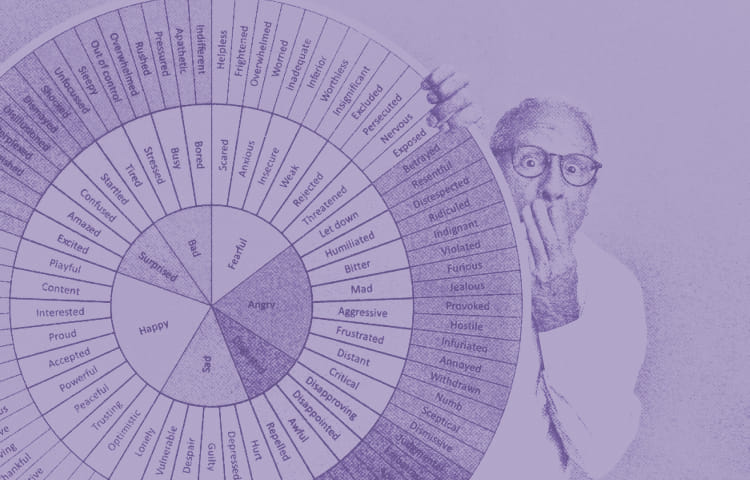


Ever find yourself caught in a whirlwind of emotions, unsure of what you're truly feeling?
You're not alone because, according to a study, a staggering 36% of adults struggle to accurately identify their emotions.
In a world where emotional intelligence is key to personal growth and success, this statistic sheds light on the urgent need for tools like the feelings wheel.
So, let's explore this ingenious invention a bit closer to truly understand how and when to use it.
In a world where emotional intelligence is key to personal growth and success, this statistic sheds light on the urgent need for tools like the feelings wheel.
So, let's explore this ingenious invention a bit closer to truly understand how and when to use it.
Key takeaways
- Developed by Dr. Gloria Willcox, a licensed clinical psychologist, the Feelings Wheel revolutionizes emotional education worldwide.
- It offers precision in identifying a wide range of emotions.
- Studies show that using the Feelings Wheel improves mental health outcomes.
- No matter if you're a therapist, student, or just curious, the Feelings Wheel provides valuable insights into human emotions that resonate with everyone.
- A free Feelings Wheel download available in the article.
What is the Feelings Wheel
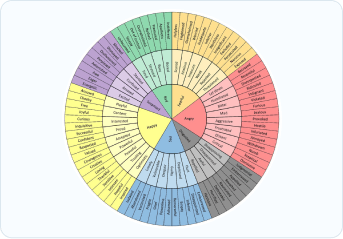
The brainchild of Dr. Gloria Willcox, a licensed clinical psychologist, the Feelings Wheel isn't just your average therapy tool — it's a potential game-changer in emotional education.
Dr. Willcox formulated this ingenious wheel to give people like you and me a visual roadmap for pinpointing and expressing their emotions with precision.
And although it hasn’t been studied much in scientific research, it’s still well-known for helping people recognize and talk about their emotions.
A study suggests there are at least 27 distinct emotions. And that doesn't even include combinations of emotions.
What this wheel does, it breaks down emotions into different levels and sections, kind of like layers of a cake.
At the core, you've got your main emotions like happiness, sadness, trust, disgust, anticipation, fear, anger, and surprise.
These main feelings are then broken down into more specific ones.
So why bother with all this emotional breakdown? Well, imagine trying to describe how you feel with just one word, like "good" or "bad." It's like trying to paint a masterpiece with just one color!
Take “sadness,” for example — it can range from feeling a little down to being disappointed or even feeling totally helpless.
The Feelings Wheel helps you pinpoint exactly what you're feeling and put it into words. It's great for self-reflection as it guides you to understand what you’re feeling and why.
It’s also helpful in noticing the less obvious emotions that still affect how you make decisions and act. But more on its benefits a bit later. Let's see first how to use it properly.
How to use the Feelings Wheel
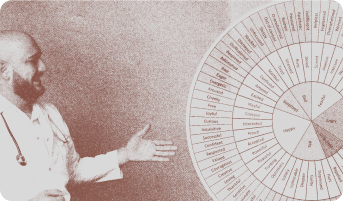

Using the Feelings Wheel begins with identifying the primary emotion you’re feeling and then moving outward to secondary emotions.
This helps to pinpoint the exact emotional state you’re experiencing.
Here's an example of how Mel Robbins is using the Feelings Wheel to gauge a person's deep-rooted feelings and emotions:

Here’s a short summary of how to use it:
- Start in the middle of the wheel, where you'll find the main emotions, such as happiness, sadness, anger, or fear. Figure out which of these basic emotions you're feeling right now.
- Once you've picked a main emotion, check out the next layer of the wheel. It's like branches coming out from your main emotion that show more specific feelings related to it. For instance, if you're feeling "sad," you might see emotions like "lonely" or "hurt" in the next layer.
- Most wheels have even more layers with even more detailed emotions. Keep exploring these layers to really nail down how you're feeling. So, "lonely" would branch out into "isolated" and "abandoned."
- As you identify your specific emotions, take a moment to think about why you might be feeling this way. This can give you a deeper understanding of your emotional state and help you make sense of your reactions and actions.

Info from the authors
We've released a new anti-anxiety app update!
Check out the all new Calmer™ app. More breathing methods and new school chapters to help you get rid of anxiety and panic attacks.
Remember, the Feelings Wheel is a guide to exploring emotions; it’s not about right or wrong feelings but about better understanding and articulating them.
What is the Difference Between Primary and Secondary Emotions on the Feelings Wheel?
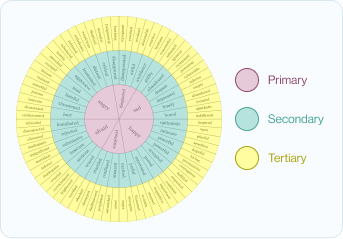
Primary emotions are the basic ones that are at the center, like happiness, sadness, anger, or fear. Secondary emotions are the more specific feelings that branch out from these primary ones.
Let's say you start with "anger" as a primary emotion from the center of the Feelings Wheel.
Secondary emotions branching out from anger might include feelings like "bitter," "humiliated," or "distant."
The wheels that have tertiary emotions, it boils down even further to feelings like "provoked," "annoyed," "dismissive," etc.
Download Feelings Wheel PDF for Free
Feel free to download these feeling wheel pdf documents. You can choose the Black & White version if you want to print it out, but don’t have a color printer:

The Benefits of Feelings Wheel
The Feelings Wheel can be your key to unlocking a world of emotional clarity and connection.
By honing your ability to navigate your feelings, you'll discover a path to greater well-being and stronger relationships.
The benefits of using the Feelings Wheel include:
Emotional Awareness
When you know what you're feeling, you can deal with those emotions instead of pushing them aside.
This makes you feel better overall and helps you handle life's ups and downs easier.
Emotional Clarity
When you understand how you feel, it helps you make sense of what's going on around you.
This means you can react in a way that makes sense, which helps you know yourself better and be smarter about handling your emotions.
Communication Improvement
When you're better at talking about how you feel, your relationships get stronger because people understand you more, and you understand them better too.
Self-Reflection
Figuring out why you feel a certain way can help you deal with the root causes, making you a better, stronger person as you learn and grow from those experiences.
What users say about their experience with feelings wheels
Lorem ipsum dolor sit amet, consectetur adipiscing elit, sed do eiusmod tempor incididunt ut labore et dolore magna aliqua.
Ut enim ad minim veniam, quis nostrud exercitation ullamco laboris nisi ut aliquip ex ea commodo consequat.


Lorem ipsum dolor sit amet, consectetur adipiscing elit, sed do eiusmod tempor incididunt ut labore et dolore magna aliqua.
Ut enim ad minim veniam, quis nostrud exercitation ullamco laboris nisi ut aliquip ex ea commodo consequat.
Duis aute irure dolor in reprehenderit in voluptate velit esse cillum dolore eu fugiat nulla pariatur. Excepteur sint occaecat cupidatat non proident, sunt in culpa qui officia deserunt mollit anim id est laborum.
Is the Feelings Wheel Good for Kids

The Feelings Wheel can be great for kids! It helps them understand and talk about their emotions, which is super important for their growth and development.
Plus, it gives them a tool to express themselves and deal with feelings in a healthy way.
Just like us adults, they can look at the wheel and point to the emotion that matches how they're feeling.
This helps them describe their emotions when talking to parents, teachers, or friends.
For example, when they're upset, they can use the wheel to figure out why they feel that way and what they can do about it.
It can also help them understand how others might be feeling, which is important for building empathy and healthy relationships.
Different versions of the Feelings Wheel
There are two main versions of the Feelings Wheel, each with unique features and benefits.
A table comparing the various versions is provided below:
| Characteristic | 🥹 Feelings Wheel | 🥲 Emotion Wheel |
|---|---|---|
| Creator | Gloria Willcox | Robert Plutchik |
| Number of Emotions | 72 | 8 |
| Core Emotions | Sad, Angry, Scared, ... | Joy, Sadness, Fear, ... |
| Purpose | Helps individuals identify... | Helps patients describe... |
Frequently Asked Questions
Here are some of the most often asked questions about the feelings wheel:
What is the Feelings Wheel?
The Feelings Wheel is a visual aid that sorts out different feelings people have. It shows a group of emotions, starting with simple ones in the middle and then moving on to more complicated feelings.
Who created the Feelings Wheel?
Dr. Gloria Willcox, a psychologist, developed the Feelings Wheel as a tool for therapy and emotional education.
How many emotions are identified on the Feelings Wheel?
The number of emotions on a Feelings Wheel can vary depending on the version, but generally, it identifies dozens of emotions.
The core emotions are usually surprised, happy, sad, angry, fearful, bad, and disgusted, and they branch out into more specific feelings.
How do you use the Feelings Wheel?
To use the Feelings Wheel, you start by identifying a primary emotion you are feeling from the core of the wheel.
Then, you move outward to more specific emotions that describe your feelings in more detail. This process helps you identify how you feel more accurately.
Who benefits from using the Feelings Wheel?
Anyone can benefit from using the Feelings Wheel. It's particularly helpful for people seeking to improve their emotional intelligence, therapists working with clients, educators teaching emotional literacy, and parents aiding their children in understanding and expressing their emotions.
The bottom line
Melatonin isn't a one-size-fits-all solution for anxiety and sleep problems. While it works wonders for some, for others, it can mess with their sleep patterns, give them terrifying nightmares, and leave them dazed and confused the next day.
Fast-release melatonin can help you fall asleep quickly, but it can also increase the risk of vivid and disturbing nightmares for some people.
On the other hand, slow-release melatonin offers prolonged sleep support throughout the night, with fewer interruptions, although it may take longer to take effect.
You need to find what works best for your body instead of just relying on what's popular at the moment.
Anti-anxiety cheat sheet
Subscribe to our newsletter and we’ll send you a 7-step guide for emergency moments when a severe anxiety or panic attack hits you.